What Business Transformation Really Means
Business transformation is the process of redefining and refining the way your company operates so it can meet the new reality. At its core, transformation is about reshaping the business to stay relevant, resilient, and competitive in an environment that never stops changing.
But what does this actually mean for a growing company? It means reviewing how you operate, how decisions are made, how technology is used, how people perform, and how your business creates value. It is not a cosmetic improvement. It is a structural shift that aligns your company with the world you operate in.
Why Transformation Becomes Necessary
A business cannot survive as a fixed and rigid structure in a fast-moving world. Many factors push organizations to rethink their models, but the main drivers can be summarized in the following areas:
1. Global Competition
Markets are now borderless. Competitors, suppliers, and customers can be anywhere. Without adapting your business model, you fall behind those who are faster, more efficient, and better connected.
2. Regulatory Compliance
Regulations change constantly, especially in areas such as data, privacy, environmental standards, and cross-border operations. Businesses that transform early avoid penalties, delays, and operational disruptions.
3. Digital Disruption
Technology continues to reshape entire industries. This did not start today. We saw it during the industrial revolution. It repeated in the digital era. And now artificial intelligence is reshaping existing systems again. Businesses that fail to adapt lose their position, their clients, and eventually their relevance.
4. Changing Customer Expectations
Customers expect faster service, better value, and seamless digital experiences. If the business model does not evolve, customers shift to competitors who listen to their needs and respond accordingly.
5. Scaling Up and Expansion
Growth is a major reason to transform. Expanding nationally or internationally without restructuring your operations creates a high-risk environment. Think of your business as a house. Before adding more floors, you must ensure the foundation and internal structure can support the expansion. If not, it collapses.
What the Numbers Really Show
The business world speaks through results. Here are relevant insights that highlight why transformation is not optional, especially before expansion:
- Around %65 of digital transformation initiatives fail to meet their goals.
Source: Mooncamp Digital Transformation Statistics 2025 - About 17 percent of IT projects fail in a way that threatens the company’s stability.
Source: McKinsey and Company via Mooncamp Report - Nearly %54 of businesses identify cybersecurity risk as a major threat during transformation.
Source: MNP Risk Trends Report 2025 - Around %63 of organizations that execute transformation properly report stronger performance and improved risk mitigation.
Source: KPMG via Mooncamp Report - By 2025, around %75 of large enterprises will adopt AI.
Source: JetRuby AI Adoption 2025 - Digital transformation success rate is estimated at 33 percent without structured planning.
Source: Backlink DX Stats - Around %62 of consumers prefer companies aligned with ESG standards.
Mooncamp ESG and DX Trends - About %50 of employees will require reskilling by 2025.
Source: Career Accelerator Canada
These insights highlight a simple truth. Growth without planned transformation is not expansion, it is exposure. But when the transformation is done correctly, companies experience higher performance, stronger resilience, and long-term stability.
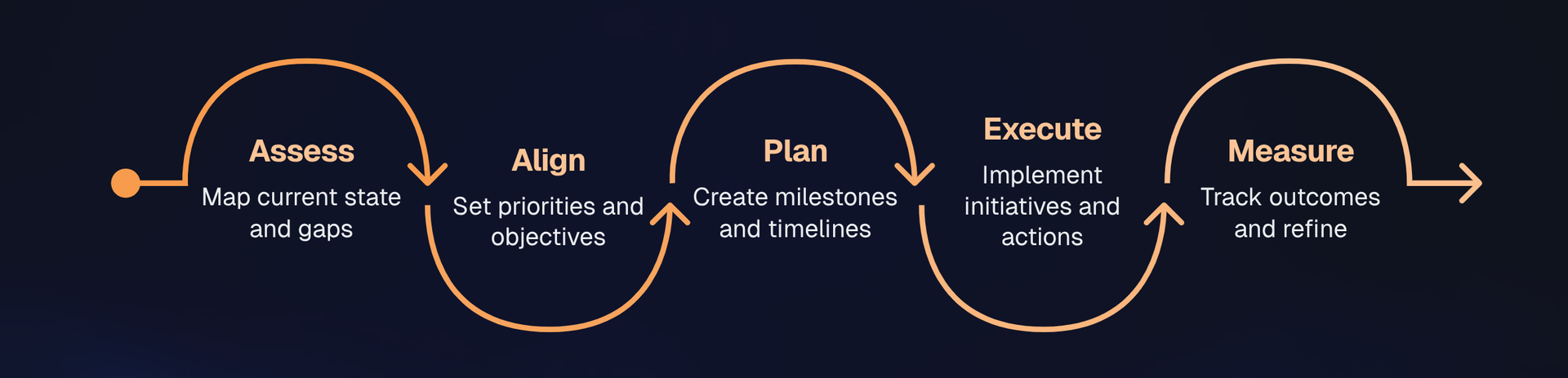
The Transformation Roadmap
Reaching this point means you understand the essence of business transformation and why it is essential before expansion. The next question is how.
Transformation is a process, not a template. Every business has its own structure, culture, and challenges. This is why transformation must be customized and implemented in progressive cycles. A dedicated transformation expert helps you navigate complexity, connect the right dots, and focus on the strategic decisions that matter. This is not a one-time project. It is a long-term journey that prepares the business for stability and future growth.
After Transformation: Sustaining the Impact
Transforming the business is only half of the journey. Sustaining the results is the real challenge. If the in-house leadership team and frontline staff do not develop the capability to manage the new systems and processes, the transformation loses its impact.
Training, knowledge transfer, and continuous development are key. Without elevating internal capacity, the business eventually slides back to the old ways of working.
Watch our LikedIn Live: Business Transformation: Pre-Expansion & download the presentation